Projecting the value of CreelMT in a Two-Machine Operation
| CreelMT Case Study |
Creeling has always been part of carpet manufacturing.
Yarn packages are loaded. Creels are prepared. Pattern changes take place. Partial cones are stored for possible reuse. Labour, downtime and excess yarn are accepted as part of the process.
For many manufacturers, conventional creeling is not considered a distinct production problem. It is simply how carpet has always been made.
That does not mean it doesn't cost the business money.
A recent CreelMT assessment considered what automated yarn creeling could mean for a smaller carpet tile manufacturer operating two patterned tufting machines. The projected result was an annual operating benefit of about US$1.43 million, the release of about US$170,000 in working capital, and an indicative simple payback of about 21 months.
The opportunity hidden inside a normal process
The manufacturer’s patterned production environment required more complex designs, greater colour variation, and shorter production runs.
Its tufting machines could provide flexibility. Its yarn preparation process still relied on cone packages, manual creeling, and conventional pattern changes.
This created costs across several connected areas:
-
- Yarn had to be purchased in cone quantities rather than the precise lengths each production run required.
- Partial cones remained after jobs and became difficult to reuse efficiently.
- Creel preparation required substantial manual labour.
- Pattern changes interrupted productive tufting-machine time.
- The company had to maintain inventory to preserve manufacturing flexibility
- Creeling and yarn-placement errors created waste and quality risks.
Individually, each cost could seem unavoidable. Together, they represented a substantial commercial opportunity.
Go to download the full customer case study now >
What changes with CreelMT?
CreelMT uses yarn-consumption information from CAD, tufting machines, or other production systems to determine the yarn required for each job.
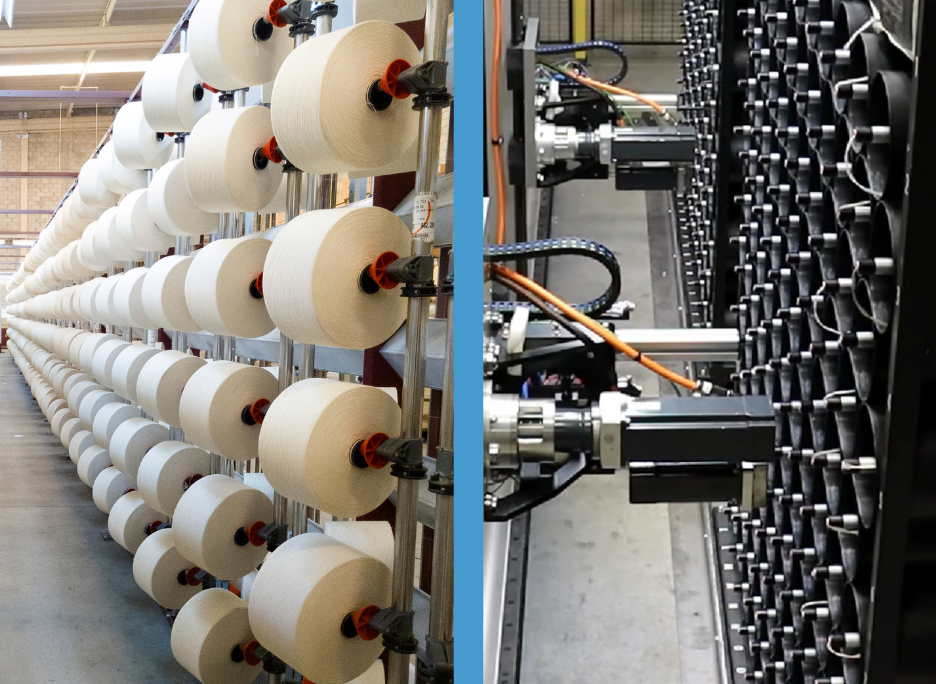
Precision winders prepare the required length for each needle position. Robotic package handling transfers the prepared yarn packages to mobile creel trolleys. Operators can prepare these trolleys offline while the tufting machines continue producing.
The new creel set can then be beam-spliced into the tufting machine, connecting up to 130 yarn ends at a time.
This changes creeling from a largely manual support activity into a digitally planned production input.
Five sources of projected value
The two-machine assessment found that the business case did not depend on a single labour-saving claim.
The projected annual benefit came from five areas:
-
- US$184,000 from improved yarn utilisation
- US$600,000 from reduced creeling labour
- US$375,000 from recovered tufting-machine capacity
- US$238,000 from reduced waste and production errors
- US$34,000 from lower inventory carrying costs
Yarn losses were projected to reduce from approximately 9.0% to 2.5%. Pattern-change downtime was projected to drop from about four hours to about one hour.
A projected 30% reduction in yarn inventory could also free up about US$170,000 in working capital.
A different way to evaluate creeling
This case is not simply about automating a labour task.
It shows what can happen when you examine creeling as part of the manufacturer’s wider material, production, and commercial system.
A process doesn't have to be recognised as a problem before it can hold a valuable opportunity.
The figures in this case are projections based on one CreelMT supporting two comparable patterned tufting machines. Actual benefits depend on each manufacturer’s machine configuration, yarn consumption, product mix, change frequency, labour model and ability to convert recovered production time into saleable output.
Download the full two-machine CreelMT case study to review the operating assumptions, projected results and commercial value in greater detail.