
Is Your Creeling Process Hiding a Much Larger Commercial Opportunity?
| CreelMT Case Study |
Few carpet manufacturers would describe creeling as a new problem.
Yarn has always needed to be prepared, loaded and connected to the tufting machine. Pattern changes have always required labour and production time. Yarn has always been purchased in cone counts, leaving partial cones after shorter runs.
These conditions are so established that they are often treated as part of the basic economics of manufacturing carpet. However, accepted does not necessarily mean efficient.
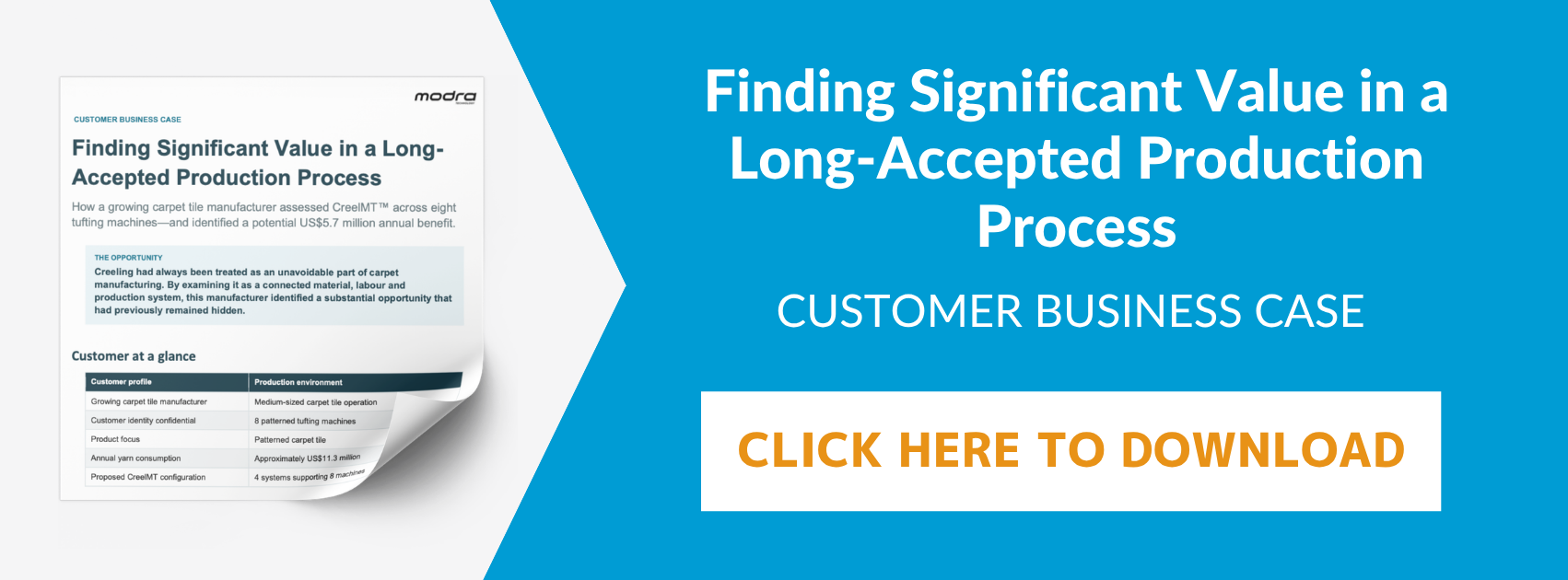
For one growing carpet tile manufacturer, reconsidering creeling as a connected production and commercial system revealed a potential annual benefit of approximately US$5.7 million.
Go to download the full customer case study now >
The costs were visible, but not connected
The manufacturer operated eight patterned tufting machines and consumed approximately US$11.3 million in yarn annually.
Individually, many of the costs surrounding creeling appeared to be normal operating requirements:
-
Yarn procured in cone counts rather than precise production lengths
-
Partial cones remaining after jobs
-
Labour required to prepare and change creels
-
Tufting machines stopping during pattern changes
-
Yarn inventory held to maintain production flexibility
-
Production waste caused by creeling and yarn-placement errors
None of these necessarily appeared large enough, on its own, to force a fundamental change.
The opportunity became clearer when they were considered together.
Why shorter and more varied production changes the equation
Modern patterned tufting machines let manufacturers produce greater design complexity, more colour variation, and shorter production runs.
However, the traditional creeling process was developed for a different production environment.
When yarn must be purchased and prepared in cone counts, the gap between the yarn available and the yarn required can grow as runs shorten and product variety increases.
More changes also mean more creeling activity and more interruptions to productive tufting-machine time.
The flexibility of the tufting equipment can therefore expose the limitations and hidden costs of the process supplying yarn to it.
Looking beyond creeling labour
Automated creeling can easily be categorised as a labour-saving investment. Labour is important, but this assessment found that it was only one part of the potential return.
The manufacturer’s business case identified five connected sources of value.
1. Improved yarn utilisation
CreelMT prepares the required yarn length for each needle position using information from CAD, tufting-machine or production systems.
For this manufacturer, reducing assessed yarn loss from approximately 9.0% to 2.5% represented a potential annual benefit of approximately US$735,000.
2. Reduced creeling labour
Traditional pattern changes required four to six people and approximately four hours of creeling work.
Automating package handling and preparation could substantially reduce this requirement. The potential labour benefit across the assessed production fleet was approximately US$2.4 million annually.
3. Recovered machine capacity
CreelMT allows mobile creel trolleys to be prepared offline while tufting machines continue producing. Beam-spliced connections can then reduce the time required to connect the next creel set.
Reducing the changeover window from approximately four hours to approximately one hour could return valuable production time to the eight tufting machines.
The potential value of this recovered capacity was assessed at approximately US$1.5 million annually.
Importantly, recovered capacity creates financial value when it can be converted into additional saleable production, improved delivery performance or avoided overtime and capital expenditure.
4. Reduced production waste
Creeling mistakes, incorrect yarn placement and related errors can create avoidable waste, rework and quality risk.
The assessment attributed approximately US$950,000 in potential annual benefit to reducing these losses across the production environment.
5. Lower inventory requirements
The manufacturer carried approximately US$2.3 million in yarn inventory.
More precise yarn planning could potentially reduce this requirement by approximately 30%, releasing around US$680,000 in working capital and reducing annual inventory carrying costs by approximately US$136,000.
The assessed result
Analysis using the Modra CreelMT Production Estimator indicated that one system could support two tufting machines in this production environment.
A proposed configuration of four CreelMT systems supporting eight machines was assessed to provide:
-
Approximately US$5.7 million in potential recurring annual benefit
-
Approximately US$680,000 in potential working capital release
-
An indicative overall payback of approximately 21 months
These figures represent an evaluated investment case based on customer operating data. Actual results will depend on implementation, utilisation and the manufacturer’s ability to convert recovered capacity into productive output.
The real question to ask about creeling
The most useful question may not be:
How much labour does it take to load a creel?
It may be:
What is the combined commercial cost of supplying yarn to our tufting machines in the way we do today?
That wider question brings yarn utilisation, labour, machine availability, waste and working capital into the same assessment.
For this manufacturer, it transformed creeling from an unavoidable production task into a potential US$5.7 million annual opportunity.
Download the full customer case study below to examine the production environment, the proposed CreelMT configuration, and the assessed sources of value.